If any American film of the last ten years speaks to us on a human level it is Ken Lonergan’s  You Can Count On Me – starring Laura Linney as the single mom Samantha Prescott (Sammy), saddled with more responsibility than she knows what do with.  Brought into the mix are a taciturn son Rudy (Rory Culkin), problematic brother Terry (Mark Ruffalo) and indecisive boyfriend Bob (John Tenney).

You Can Count On Me reminds me somewhat of the fiction of Flannery O’Connor, although O’Connor dealt with the South and this film does not – and yet, both O’Connor and Lonergan have a similar mission statement.  For O’Connor, the challenge was to portray decidedly fundamentalist Southerners in such a way to contrast their belief systems with a type of compassion that Catholics seem more apt to embrace than Southern Baptists.  Lonergan has a similar mission statement (he himself plays a priest in the film) in that a pervasive attitude of empathy and compassion become what drives the characters. Both O’Connor and Lonergan can be said to embrace a Christian Realism (or humanism). For Lonergan, this exploration ends with reconciliation and forgiveness – the ability for characters to recognize their own flaws and forgive them in themselves and others – that the film so eloquently conveys.  For this reason Lonergan is unlikely to be accused of the nihilism that some say haunts O’Connor’s work.
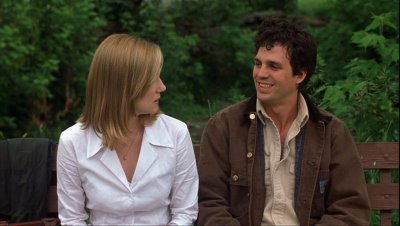
The film also poses a question: where are the strong men?  Or rather – what is the changing definition of womanhood and manhood – and by inference, strength?   Sammy has no husband because her ex was decidedly authoritarian and anti-female – or at least anti-feminine. Sammy’s brother Terry informs Rudy Jr. that his father ‘always had to show he was better’. Rudy Sr’s attitude is competitive and domineering while Terry relates to Rudy Jr., several years his junior, as a peer.

Linney’s character of Sammy brings together masculine and feminine traits – she dominates her boyfriend Bob and seeks non-committal sex outside of that relationship. Linney becomes an emblem of the modern woman who must fend for herself.  The responsibility she bears is brought on by the reality of her son – and the reality of the death of her parents – who both died in a car accident. She now takes on the role of her mother and father, minding the house as the responsible core of the family, whereas brother Terry drifts in and out of relationships and jobs, not willing to commit, nor be a disciplinarian. But Sammy too, is unwilling to commit. In the end, the brother-sister relationship is what binds the family together, and why Sammy cannot bear to see Terry part as the flawed proxy father-figure of the family.  That her most important relationship must be her sibling – and by inference, sexless – tells us that Sammy has a fundamental problem with submitting to a dominant male resulting from the dysfunctional relationship that she had with her ex Rudy Sr., and displayed in her need to dominate her boyfriend Bob and have non-committal sex with her boss (played by Matthew Broderick).

In an uncertain world, drifting values and drifting responsibilities lead to weakness in men. We also live in a permissive age in the West, and have for many decades, where we are allowed essentially free reign regarding many moral issues and see any encroachment on this as negative. Sammy is reacting to such a state. Sammy seeks a father figure in her Father Ron (played by Lonergan) and wants him to tell her “she’s going to hell” for having sex with her boss – something he refuses to do.  She seeks a God that no longer exists – a father figure for her son and herself – but the world will not provide one. Again, the definition of ‘strength’ is at issue – for clearly strength is not what Rudy Sr., her ex, displayed. Nor is it displayed in her boyfriend Bob, nor Priest Ron who believes that God forgives all. Where then, lies strength?

To Lonergan, the now anachronistic strong father is missing and God is Dead. Or at least the God that we knew that demands anything of us. The New God – one might say the New Testament as portrayed by Father Ron – is decidedly compassionate and, in a strange way, nonjudgmental – as indecisive as her boyfriend Bob, who seems to have little reaction when Sammy decides she doesn’t want to marry him. Lonergan’s God is one that is compassionate yet guiltless — and Sammy is faced with a life that holds the possibility of being both liberated from guilt and defined on her own terms as a woman. She seems to long for someone to be accountable, and the only answer is to look at herself.

What is left when God is both absent and unaccountable is people’s love for one another, or the possibility of such. From the film’s perspective, this is where real strength lies. Lonergan’s absent God leaves us to fend for ourselves in a melancholy sense of abandonment, much as Terry, Sammy and Rudy Jr. were abandoned by their parents when they died in a fatal accident. But that abandonment was not due to choice, but fate. This fate brings promise and loss.

When confronted with tragic fate, what do we do? When God is no longer present, and we feel the absence of God, what do we do? The Buddhists actually belief there is no God – that god is in fact ‘emptiness’ and out of that emptiness we, as humans, can forge a compassionate world.  It is this emptiness that pervades You Can Count On Me, where the only thing you can count on is a melancholy sense that we have lost something that cannot be regained unless we embrace a compassionate and forgiving attitude toward one another, and find strength in those bonds. As such the film is a Buddhist, and humanist, treatise on human possibility absent an Old Testament God.

Like my own film, Clouds, Lonergan’s film was released just prior to our Decade of Terror – where unaccountable “strength” has ruled supreme and we are dealing with its ramifications.  Both films  showed a promise of human relationships and a definition of men and  manhood that would be walloped by the Bush years – a time where we sought to react to the moral drift apparent in You Can Count On Me.  Interestingly, Lonergan has had many problems making films since then, but will (hopefully) release his next feature, Margaret, by 2011. The Bush years saw Lonergan pretty much absent from film, except for a screenwriting stint on Gangs of New York (directed by Martin Scorsese).

I found it interesting that Martin Scorsese executive produced Lonergan’s film. Scorsese is a Catholic (although by his admission, a ‘lapsed’ one) and loves the kind of compassionate and humanistic reflections on existence portrayed in Italian Neo-Realist films. But Scorsese does not often venture into the territory of You Can Count On Me, not at least since Alice Doesn’t Live Here Anymore – another film about a single mom with relationship issues. Let’s hope that Scorsese will continue to support this kind of film.

My sense is that over time You Can Count On Me will be seen as a singular American Masterpiece of humanistic storytelling. And let’s hope Lonergan will turn again to this type of material in the future. It has long been absent in American filmmaking, and much more needed. While we’ve seen one You Can Count On Me in the last 10 years, how many comic book movies have we been asked to endure?
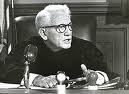
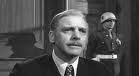
Viewing Stanley Kramer’s and Abby Mann’s Judgment at Nuremberg, almost 40 years after the film was made and over 60 years since the proceedings on which it was based have passed, proved illuminating to me on a few levels. First, the film shows that an intelligent and nuanced discussion of the issues surrounding World War II were and still are possible, and second, that Spencer Tracy is perhaps the greatest film actor to have ever lived.

As for the first point, let’s turn for a moment to the recent fall from grace of Helen Thomas.  Helen Thomas, who served for many, many years as a celebrated journalist, is summarily judged and executed (to the extent we can do so today) for making remarks about Israel that are deemed, by conventional wisdom, to be disdainful at best and downright perverse at worse – bordering  it would seem on moral depravity.  Absent from the Helen Thomas media judgment, her subsequent apology and the universal assumption that she was completely off her rocker, was a nuanced discussion of her statements, and any analysis of those statements that would have contextualized them.  To get such a contextualization we need to turn away from ABC, CBS and CNN, and toward Judgment at Nuremberg.

As for Helen Thomas’ views, there are at least a few Orthodox Jews that actually voice the exact same opinion that Helen does regarding  how the “Jews should get the hell out of Palestine.” These Jews, apparently in the minority (I have not researched this) quite literally would support every iota of Helen Thomas’ viewpoint.   Now, since I myself have befriended, roomed with, worked for, and loved those of the Jewish faith and/or culture I don’t think I am a good candidate for either anti-Semitism nor an educated discussion on the veracity of Zionism.  However, I can say what I see – and what I see is that the mainstream media in utterly incapable of entering  into a rational, even-handed debate regarding the validity of the Jewish State’s position against Palestine, and the efficacy of the Jewish State as the solution to the issues surrounding World War II.

That said, such a debate was not the point of Judgment at Nuremberg, although the Helen Thomas incident underscores how World War II continues to be a pervasive event surrounding the American psyche, because the extension of that war exists with us to this day.  If any war could have been said not to have ended, it is that war.

What was the point – or points – of Judgment at Nuremberg?   Let me try to summarize them here.  First, that a level of personal responsibility lies with all people for the atrocities that are committed by their leaders.  Second, that this moral responsibility grows out of a fundamental understanding that all human beings are of value and are therefore due to be treated with equal justice based on the rule of law.  And third, that large crimes begin with small ones.

Burt Lancaster’s character Ernst Yanning asks Judge Dan Haywood (Spencer Tracy) at the end of the film (I paraphrase): “You must believe me that I did not know that it would come to what it came to.”  As for Haywood, he replies: “After the first murder of the first innocent allowed, you knew what it would come to.”  Such words can be echoed today to any American, any person who allows atrocities to continue without speaking up.

In his closing remarks, Tracy’s Haywood stated quite eloquently that “every human being is of essential value.” Why was that important?  It was important because it is only in dehumanizing others that atrocities can occur in the name of the State.  This can happen today on many levels in many guises, and is a disease which humanity seems ill prepared to rid itself of, although there are those that continue to try to raise the rationality of humanism above fascism.

Finally, large crimes begin with small ones.  It is the first compromise that leads to the larger one that leads to the massive crime.  We can look to our recent financial failings for examples. Take Bernard Merdoff, or Enron, or shaky derivatives deals.  All begin with rationalizations, excuses, small crimes and cutting corners.  Eventually, the whole society is rotting and a culture of corruption, buttressed by a fundamental dehumanization of self and others, takes hold.

Who judges the judges?  That becomes a searing question for us, as Americans, today, posed by Judgment at Nuremberg, where American judges quite literally sat in judgment of their Nazi counterparts.  Where are those judges today?  Many that voted for Barack Obama had prayed and hoped for some kind of resolution to questions of Iraq, open questions regarding 9-11, and a real debate regarding the veracity of our financial system.  Questions that could be explored and debated in the light of day by a people’s tribunal of sorts, so perhaps we could begin the process of healing and transcending what we know are probably crimes against humanity, committed not by Nazis but by ourselves, who have become in essence the criminals, either directly or indirectly.

What occurs with the national psyche, just as with individual psyche, is this corruption, when not illuminated, when not brought to light and justice, festers and expresses itself in another way.  And what better a symbol of that expression than the current Oil Spill. The toxicity of our system is literally washing up on our shores.

Do we address the internal toxicity that leads to the external?  It seems not. For there are questions of country, questions of jobs, questions of money, questions of practicality, questions of ‘the survival of the country’ that arise to dissuade us when such a truth and reconciliation movement is desired by people. Arguments of ‘survival’ that were made by all of the men and women who compromised Germany at the time of the Nazis, who were themselves seen by most  as the only viable vehicle for national salvation.

Where is our truth and reconciliation committee?  Where is our Judgment at Nuremberg? While we are constantly told ‘not to forget’ the atrocities of World War II and 9-11, what of other atrocities that occurred yesterday?  What of dozens of innocents killed by un-manned drones in Afghanistan? What of the hundreds of thousands of Iraqi civilians killed for no reason in the last 10 years?  What of Rachel Corrie being bulldozed in Palestine?   What of the monks being tortured in Chinese-occupied Tibet?  We justifiably hold the emblem and horrible reality of the Jewish Holocaust as that which we will ‘not forget.’ And yet every day we are encouraged to forget other atrocities because they do not serve our interests.  But what of the human interest?  What of the interest of justice?

But we are in a new era. This new era has no Spencer Tracy, apparently – who himself, in reality, was just an actor, a myth of our own purity.  Myth or not, we have no wise old men, for they are corrupted, or corruptible.  We have no Sam Ervin, who led the Watergate  Committee.  What the powers that be do not understand is that we are destroying ourselves by not allowing ourselves that transparent self-criticism that we need with Iraq, with 9-11, with the financial system, and with other issues.  It is impossible for a rational human being to exist in this situation, knowing what they know, and not to demand justice on some fundamental level.  Without it we wither and we end up with the type of justice we provided Helen Thomas, who, like Spencer Tracy’s wisdom, is apparently an anachronism, and easily discarded as we move on to the next news cycle.  A news cycle that seems strangely to conspire against our awareness, even as its false sense of urgency touts its importance to us all.  What is lost is wisdom, the type of wisdom seen in Spencer Tracy’s Dan Haywood.

And yes, Spencer Tracy.  What is it about the man? He was, after all, just an actor. He was, apparently, a flawed man.  But there was a greatness about him, and certainly a greatness in his acting, an honesty, a transparency into the inside of the man, the weariness of the man, the burdens of the man.  It would do us all good to look at Judgment at Nuremberg again and again, to look into the craggy face of Spencer Tracy and recognize that if we can imagine such a man, such a wise man, that we as human beings, by the very force of that imagination, may be able to find ourselves out of the round of delusion and myth we seem so content to live with.  To imagine, indeed to find, some measure of justice  and enlightenment, in these days where such things seem so passé, so impossible, and yet, so needed.

We elected a Black Man hoping he would replace our lost Spencer Tracy.  Certainly he is up to the task. However, it also seems to me that he, our President, is not listening to what people crave.  He is not seeing what we need as a nation.  We need truth. We do not need to kick more ass regarding an issue which is tangential to the real issue: that we are lying to ourselves, and getting rather used to it.

I didn’t actually meet Howard Suber until I was a graduate student in the UCLA Film Studies program, although I had taken his (required) film studies courses as a motion picture television program undergraduate.  I took two film studies seminars with him as a graduate and enjoyed every minute.

The first paper I wrote for the first seminar I took with him was quite memorable.  I wrote an essay about ‘Merry Christmas Mr. Lawrence’ – frankly, I don’t remember exactly what the theme was.  After handing in the paper, and while attending the next class, Suber stood in front and read my essay out loud.  He said he had done that once in a while with essays he felt were exceptional.

While I barely said a word in any of his seminars, he gave me an A+.  Little did he know that he inspired me to want to continue to write about film and culture, and provided confidence that I maybe knew what the hell I was doing.  Suber even attended my wedding, and recounted to my father the story of him reading the paper in front of the class.  My Dad said it made him exceptionally proud.

After graduating with my Master’s from UCLA,  I didn’t write about film again for many years.  While I was accepted into the film criticism PhD program, and even received the Chancellor’s Fellowship (the highest academic honor from UCLA at that time), I chose not to pursue an academic career.  Instead, I got married, studied computer science, began working in New York City, and eventually made and raised enough money to produce the film that I had written while at UCLA as an undergrad, CLOUDS, and founded my production company nextPix.  Later, after 9/11, I founded the SolPix webzine with Mike Neff and wrote a lot about film in a way that was reminiscent of my graduate seminars with Suber.

In short, I never forgot my love of film nor of my experience at UCLA.  After my wife and I moved from New York, I found myself wandering back to my academic roots.  While googling for Howard Suber,  I discovered he had written a book called ‘The Power of Film’.  I immediately ordered it, and would like to discuss a little about both Suber and his book here.

Howard Suber was unique as a teacher in that he did not have a particular theoretical framework.  If he did, it would probably be Northrop Frye’s Anatomy of Criticism.  He certainly was not a Marxist or a Freudian, nor a Historicist.  He was rather incredibly practical and accessible.  He talked about films, mostly popular American films, in a way that the students understood.  While some of the professors would confuse students with their complex, and often brilliant, meanderings about a single core idea rooted in this or that critical theory, Suber was a fountain of dozens of observations and anecdotes that he jotted down in hundreds of pages of notes, and revealed to his students as a sort of gift to their potentiality.  What he lacked in methodology he made up for in insight.

‘The Power Of Film’ in an anthology of those notes that was first published in 2006.  As I read through it I was reminded of his classes and some of the ideas that stuck with me.  It is these ideas that he provide about the ‘why’ of popular films that so many people eventually used in so many films after they studied with him.  Not so much in the way of formula – he devised no easy 12-step program for filmmakers – but rather in individual elements used in great films that enabled them to tap into the popular Zeitgeist.

As such, ‘The Power Of Film’ could just as easily be called ‘The Elements Of Film Style’.  Arranged alphabetically, Suber outlines each element and provides examples from hundreds of ‘memorable, popular’ films in a way that it becomes a kind of reference or primer for the filmmaker.  Again, not as a cookbook, but more of a compendium of those elements that empowers popular filmmaking.

If Suber has a big idea in his book, he is much too self-effacing to state it.  So I’ll do it for him here.  The big idea of his book is that popular, wide appeal, and memorable films are less works of art than political campaigns (this could be why Hollywood and Washington are so similar).  This is, according to Suber, because popular films do not so much speak to the least common denominator as they do appeal to a wide swath of often contradictory constituencies.  Pixar I would cite as the most recent and best example of what Suber is talking about.  Pixar films appeal to both young and old, conservative and liberal.  I would add that the memorable, long-lasting ones tend to be humanistic.  Perhaps if Suber writes another book, he could look at the relationship between popular film and politics – I think he’d do a great job!

It is this ability to tap into various, often contradictory constituencies that make many popular films paradoxical.  I would add at times this becomes so self-conscious for modern producers that they end up with a film that uses the first half of the film to outline one worldview, then spends the second half dismantling it. But these often end up on the list of the non-memorable.  The memorable, on the other hand, manage an integrity to their storytelling that is neither self-conscious nor patronizing.  Again, Pixar is a great example here.

My concern with recent film trends is that we sometimes tend toward the mythic rather than the humanistic; as Suber might say, we opt more for Homer and less for Sophocles.  One thing I did get from other professors at UCLA was there was value in looking at the social context of film, in the case of Marxist /Structural analysis, how films are produced, who produces them, and for what reasons.  And while we may say ‘to make money’ films do, through the grinding influence of bean counters and a corporate philosophy, become vehicles for a Homerian mythic style that is at its core intent, for example, teaching (mostly) young men about aggression, competition, and battle.  While that is a vast oversimplification, the easy relationship between video games and mythic blockbuster films can not be ignored.  And the fact that our society spends ten times its nearest competitor (China) on military spending, and has a far smaller population, cannot be ignored.  Is this all ‘bad’?  Probably not.  But it certainly is worth discussing as we face tough cultural choices in the future that may go at the heart of our competitive, aggressive, and militaristic tendencies.  Moreover, perhaps recent popular films are trending more romantic than militaristic, less Sly Stallone and more Sandra Bullock.  As such Sandra Bullock is a political statement and in cahoots with the Dalai Lama.

Suber also does not really discuss the ‘American Independent’ phenomena.  Again, his criteria is ‘memorable and popular’.  As such, he harkens back to a day when there was not such a split between popular films and independent films that are opting to speak to a different audience for different reasons.  Some of the elements he describes have in fact been lost on many modern blockbuster producers and might be remembered again.  James Cameron and Harvey Weinstein are probably the closest to being producers of the Suberian mold, but there could be more.  In short, every producer of popular films, and every independent filmmaker and student of film, should read Howard Suber’s book if they want to understand great American films, and the ideas and instincts of the great showpeople that were behind them.

It was about 10 years ago that Diana Takata and I founded nextPix with Dr. E Ted Prince, and about eight years ago when I met Mike Neff and we started the SolPix webzine. This new SolPix Blog will continue discussing many of the ideas that were initially put forward on both the nextPix website and the SolPix webzine. I’m glad to be back after a 2-year hiatus from SolPix.

In 2000, in an essay titled ‘The New Media Age’ – and even as early as 1993 in a piece called ‘The Digital Tribe’ — I outlined what I thought were some trends in the media for the future. A lot of what I considered actually came to be – trends that led to YouTube, Social Networking, increasing media fragmentation, micro-niches, media democratization and so on, have come to be reality.

While these trends continue to evolve, we’re also faced with different challenges. While the last twenty years have indeed been revolutionary, driven by a combination of new technology and the War on Terror and the subsequent backlash so many of the Bush policies brought about, we are now in the age of Obama. What does that look like? What is the media future under Obama?

My sense is that this decade will prove to be just as transformative as the last, with much of that transformation, particularly within the United States, involving a continued re-assessment of our core values. While many people are diving headlong into change, many more are trying to hold onto old ways of thinking and old models of behavior.  However, I think that we are in a time that will allow for nothing short of change that could, by the force of events, be extreme, driven to a large extent by continued economic upheaval and shifts. Ultimately, I think we’ll end up in a better place – I guess that makes me an optimist!

So what we might have is an opportunity. For those interested in making media, it can be an opportunity to find oneself in one’s vocation rather than just another way to make a buck. Media people should look to the trend in ‘B’ corporations (more on that below). With the days of Enron, WorldCom, and the Wall Street meltdown (hopefully) behind us, this new socially-responsible business sector should have its mix of media providers. It’s already happening: we have Participant Media, Chicken and Egg, Human Media, DogWoof, Clear Films and nextPix. We need more like them. These companies are promoting a new kind of ‘B’ movie.

Because digital media can, on the low-end, be so cheaply produced, and (with a little talent) can even be of relatively high quality, many documentary filmmakers and citizen journalists have stepped up to the plate, showing us a sea change in media is possible. These filmmakers and journalists have used digital technology as a vehicle to express what their passion is – often in a way that helps others. I am in fact astounded by the number and scope of documentary filmmakers that use cheap digital means to express some form of altruistic intent.

Moreover, the rise of so-called ‘B’ (for Benefit – often hybrid profit-non-profit) corporations reflects the desire of people to connect their values with their wallet. But the idea of businesses being responsible for something more than the bottom line – that companies exist interdependently with both society and the environment and therefore must act responsibly – has yet to take hold in the mainstream media, where such ideas often have little sway.  For one, first amendment rights make any concept of ‘media pollution’ problematic, even though many people feel that there is a lot of media pollution in so-called entertainment – much of which many of us know is patently awful. But unlike environmental pollution, there often isn’t a direct or easy corollary to physical or mental harm – although studies do continually show that certain kinds of media do in fact create negative behaviors.

But legislating morality is, in my view, not the path to media enlightenment. Rather, promotion of humanistic values is a better path. We do not, in my estimation, need another Hays Code.  I have stressed this on the nextPix site and projects and to some degree in the SolPix webzine. What do I mean by ‘humanistic’? My own inspiration comes from three main sources: Italian neo-realist filmmakers, the founder of the New Humanist Movement, Mario Rodriquez Cobos, and the Dalai Lama.

Of the Italians, the films of Rossellini and De Sica had a profound impact on me during my studies at UCLA. What these filmmakers had to say, in the wake of WWII, was profoundly moral and courageous, told through stories of stunning simplicity. Cheaply made, you might call them ‘B’ movies with a purpose.  American Independent filmmakers should look to these masters from Italy for renewed inspiration.

So SolPix is back, and we’re here to give you our two cents worth on what’s going to happen next in the media revolution (or to some, de-volution) we call the 2010’s. It’ll be serious, but not too serious. If there’s one thing I’ve learned, taking oneself too seriously can have a serious (no pun intended) downside. I think we’re all ready for the upside again – even if that winds up being just hanging out and having a good time on the Web.

I’ll share with you what I wrote In 1993. I think it was pretty forward thinking – but then in fairness I got many of the ideas from others who were still more forward thinking. I just happened to be listening.

A revolution in perception

The globalization of media and the proliferation of telecommunications will allow for a break on the hold of traditional media and the view that it purports. Media will become universal and democratic. Many points of view, hundreds or even thousands of points of view, will all be given equal weight. In this new landscape, the information consumer will pick and choose among the vast landscape of information, brought to them through agent software that reflects their very personal perspective.

Neither the State nor the Networks in the name of Democracy can control media content. The whole situation is a floodgate of awareness, because the implications of hundreds or thousands of perspectives being simultaneously available are the seeds of a revolution in perception. That is, the viewer becomes a powerful editor of their own reality. Responsibility for perception shifts from media owners to media perceivers. In turn, the perceivers themselves may add to the overall mix of media, through an increasingly powerful public access infrastructure.

The whole situation will call into question the current media power structures. Technical expertise and understanding of how to create “commercial” media will be in many ways usurped by the ability to resonate powerful truths above the mass of mere information. Media manipulation will become increasingly easy to perceive, call in to question, and address. There will be no secrets anymore, unless we want them because we fear the responsibility of self-awareness. On the other hand, truth will be harder to decipher, and more valuable when it is found. Truth will stand out not through any single perception, any one artist, priest or purveyor of enlightenment, but in the cracks between those perceptions. Relativity becomes not only theory, but perceptual fact, moving from the brain of Einstein to the mass consciousness.

—excerpt from “The Digital Tribe” by Don Thompson, 1993

We’ll start with this blog, and then see where it takes us.  We’ll try to keep it interesting, for sure.