Rather than run down to the Cineplex to see the latest Hunger Games installment (that will come later), I chose to spend Thanksgiving weekend perusing some old classics and one more modern parable. The classics where two films of Michael Powell (Contraband [AKA Blackout] and The Edge of the World) and one from Mihalis Kakogiannis  (Zorba the Greek, based on the novel by Nikos Kanzantzakis). The modern parable was Robert Redford’s The Legend of Bagger Vance. The juxtaposition of these films got my mind percolating about how we as human beings make choices. Choices can be driven by desire, by love, by revenge, or by wisdom.  They can also be fueled by the intent to have a positive influence on those around us. Or choices may seem forced upon us by external influences. In many ways, all stories, and all films, are about choice.

But first a bit of history. What was interesting about Contraband is, for one, that it was a collaboration on a couple different levels, one short-lived, and the other more long-lasting. The short-lived collaboration was between Powell and the British Government, who were at that time (1939) in the thick of WW II and apparentlyContraband54 attempting to coax neutral counties (i.e. Scandinavian countries) into siding with them against the Germans. The central character is a Danish captain (played by Conrad Veidt) of a ship marked as ‘contraband’ – its cargo to be funneled through Denmark and eventually to end up in Germany. The British were keen to limit contraband to the enemy, and let countries that provided contraband  know that they were serious about quarantines of goods that might end up in the hands of Germans. The Captain’s choice rose out of tension between a sense of duty and love — duty to his ship and love for the mysterious Mrs. Sorenson, played by Valerie Hobson. Ultimately love wins, but so do the good guys.

Powell’s other, more long-lived collaboration was with his director-writer-producer partner Emeric Pressburger, who Powell would later end up working with on several other classics, including  The Red Shoes, and Black Narcissus. Better known as ‘fantasias’, these films show that Powell and Pressburger became less interested in realism and more in the underlying mythic archetypes that, to him, created the mental landscape of the human personality.

While we find no such fantasy in Contraband, we do find a lot of humor. In fact, what struck me immediately about Contraband is how similar it was to another thrilling yet humorous ‘issue’ film surrounding the World War, Carol Reed’s The Third Man (1949), so much so that I am convinced that Powell’s film had a great influence on Reed and Graham Greene, the writer of The Third Man. Like Contraband, there is an ‘issue’ at play; like The Third Man there is a liberal use of humor an irony weaved within the suspense. With The Third Man the issue as tainted penicillin provided by the opportunist Harry Lime. The other great influence on both films would be Alfred Hitchcock, who is often credited with defining the spy thriller genre, epitomized with such films as Foreign Correspondent.

Both Contraband and The Third Man focus on choice as the central arena through which the human story unfolds. For Contraband, it was the choice of the Captain to protect a woman out of love; in his case, it sided him with the good. For The Third Man it was the choice of Holly Martins (played by Joseph Cotton) to kill the nihilistic Harry Lime (played by Orson Welles) that becomes an emblem of the good man dominating the selfish one. Choice as a theme was also central to The Legend of Bagger Vance; for it is the moral choices made by the three golf players that ultimately define who they are.  But more on that later.

In Powell’s The Edge of the World, we find Scottish island people whose choices are infringed upon by external forces — even to the point of extinction (the population is eventually edgerelocated to the mainland). In this sense they seemed to have no choice. Similarly, in Zorba the Greek, ‘foreign’ influences also threaten the village, finally resulting in the murder of the widow (played by Irene Papas), who ‘betrayed’ the village by making love to the foreigner Basil and indirectly causing the suicide of her murderer’s young son, who was passionately in love with her. If it were not for these external influences, her options, and her choices, would have been different.
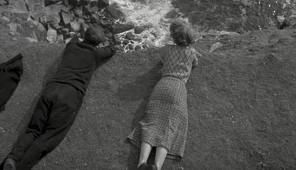
Parochialism, pride, revenge, the rule of the tribe, localism, intolerance are all thematic elements in  both The Edge of the World and Zorba the Greek. Naturally arising compassion, outside of the patriarchal structures of the church and state, appears to be the only moral compass — and choice — that can guide us. It is the individual who awakens, with empathy, toward the plight of the other that lights the path ahead.  So it is with Zorba (played by Anthony Quinn), whose response to the harshness of life was not to attend church, but to dance and laugh. This is the wisdom he gives to the ‘foreigner’ Basil (played by Alan Bates), something wholly useless to the utilitarian needs of life but completely necessary to sustain life as a human being. The other option is to shut down: to murder the mystery of life in the name of control and ritualized obedience that has become so separate from its roots as to become the opposite of its origins.

Thus, in contrast to the individualistic Zorba, the church going villagers in Zorba the Greek sing the praises of Christ’s forgiveness, while outside the church the widow who goes against the strict, and often unwritten, rule of the tribe is murdered for her transgressions. She is an emblem of freedom, in this case sexualzorba freedom and choice that runs against the grain of the community– as such Zorba was a precursor to the sexual revolution that later occurred in Europe and the United States. Moreover, both Zorba and Edge of the World were prescient harbingers of the dangers of globalization; how cultures that have existed for hundreds of years can be swept into non-existence within a single generation — to have, in a real sense, their choices removed and/or replaced by other, more utilitarian, ones. Such is the power of the consumer culture and globalization that sweeps all inefficiencies into the dustbin of history, all in the name of economic progress. Both the villages of Zorba and Edge of the World were greatly influenced, if not destroyed, by these pressures.

Many years later (2000), Robert Redford would take a nostalgic turn with The Legend of Bagger Vance, to make a modern parable about moral choice. One key scene in Bagger Vance is when Rannulf Junuh (played by Matt Damon) is made an offer by Walter Hagen (played by Bruce McGill) to play exhibition golf with him, with an ‘understanding’ that Hagen would always win the matches.  As Hagen notes, ‘there is no meaning’ in life, and ‘people arethe-legend-of-bagger-vance only interested in entertainment’. Here Redford is indirectly taking aim at the Hollywood/Capitalist patriarchy that does not believe any kind of moral instruction is necessary  to entertain the masses or to survive; in fact, if the film gives even a remote indication of the reality of exhibition golf, Mr. Hagen’s reputation never suffered from ‘giving the people what they want’. He died rich, well-respected, and well-loved. Junuh, on the other hand, made the choice to be honest, and take the penalty when his ball moved an inch or two on the final hole.
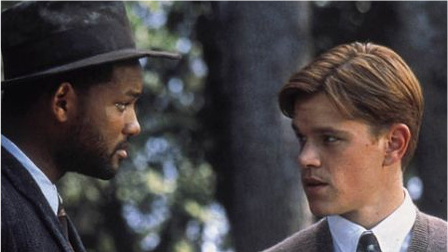
It was this moral choice that he left for the little boy, Hardy Greaves (played by J. Michael Moncrief, who later grew into the film’s narrator, played by Jack Lemmon)—it is the power of choice that Hardy took away from the experience. As for the caddy, Bagger Vance (played by Will Smith), he left Damon at the last hole once he had learned this critical lesson, which again was not about golf at all, but about making the right choices. That, for human beings, can be a very hard thing to do. Good stories, whether they be told around the campfire in tribal villages, in Churches by priests and pastors, or in the movie theater, ideally give us road maps to better choices, and how to hold on to the freedom and responsibility that comes with them.

Don Thompson is a producer/filmmaker and essayist. You can visit nextPix here.
https://www.facebook.com/bringingtibethome

We at nextPix have always felt that socially relevant media would become more and more necessary and important as we moved into the new century. Issues of global economics, the environment, poverty, oppression – along with countless other pressing social problems – would be front and center in a new media age that focused on common human values. A Place at the Table, which I had the privilege of seeing at a recent screening in San Francisco, is an example of how this continues to hold true and demonstrates the significant shape socially relevant media can take.placeattable

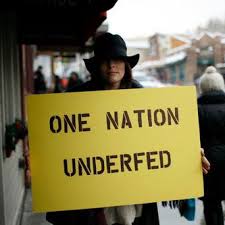
Produced by Participant, the most well-known progenitor of socially conscious media, A Place at the Table chronicles an extremely important issue in this country: hunger in the midst of apparent plenty. Directed by Kristi Jacobson and Lori Silverbush and featuring the celebrity clout of Jeff Bridges, the film delves into a paradoxical reality in America today: how we as a nation can be under and/or malnourished and yet, ironically, extremely efficient at producing vast quantities of food. The basic syndrome is known as ‘food insecurity’, and over 50 million Americans – one in four children – fall into the category of not knowing where their next meal is coming from.

The questions the film asks include: what kind of food do we produce, who consumes the worst of it, and how and why does this happen? Toward this end, the film a) conveys the problem, b) frames the debate and c) offers solutions. All three are done effectively, although in my own opinion some of the solutions explored in the film could have been expanded and elaborated on in a fashion that could reconcile the ‘left/right’ way the issue was sometimes framed.

According to A Place at the Table, a perhaps unintended but nonetheless  unholy alliance has formed between subsidized agribusiness, private food banks, charitable institutions, bad or gutted federal policy and, by implication, a health care industry that profits from a high quantity of diabetic, obese and otherwise sick people neatly provided to them by a dysfunctional system. We get quite a clear picture of who benefits from the current situation: large corporations.

The issue is fundamentally one of priorities and money: we subsidize the production of a few staple crops that get force-fed at the low (cost) spectrum of the food chain to the poor, who then can’t afford better food, and become trapped in a vicious poverty cycle that starts with being ill-fed, particularly as children. The result is kids who often can’t learn and grow up to be sick adults. To put it differently, we feed poor children foods that either buttress or in some cases create developmental challenges that keep them in endless rounds of poverty, lack of opportunity, illness and hopelessness that nonetheless keeps the large food and (by implication) health care providers and pharmaceuticals happy.

The film frames the debate by stating that the problem was, at one point, solved (during the 70’s) by visionary bi-partisan legislation starting with the Nixon administration. These visionary food programs, including an expansion of school lunch programs and adding a breakfast equivalent, were subsequently gutted during the 1980’s and replaced by private (often ‘faith-based’) food banks and charities that rely heavily on the excess production of the producers of cheap processed foods, and subsequently used to stuff the  poor with their so-called generosity. While these efforts are (sometimes) well-intended, the message is clear: food banks ran by churches and other private institutions are not providing the kind of foods that poor children need to thrive, but instead give them an unending diet of chips, cookies, cakes and – to put it bluntly all the foods the educated middle class (whether left or right) tries to avoid.

The film’s point couldn’t be more clear. We are slowly killing a certain segment of our population and that, illogical as this may seem to large corporations,  is not in the best interest of our country over the long-term. Further, much of our current policy seems to have a certain hint of insanity to it. It is the result of a focus on the profit motive outside of other considerations that (used to be) the purview of common sense and rationality of mature (mostly male) leaders,  a type of wisdom and sense of social responsibility that does not seem to be a prerequisite for entry into some of the corporate boardrooms of the mega companies that create many of the foods we consume. Perhaps that can change.

The film lays out the debate in a bi-partisan way, and is an equal opportunity identifier of legislative stupidity and policy myopia.  However, it is mostly the Republican right, from Reagan forward, that gets the brunt of the blame for the current situation. To be sure, the solutions offered could  be a little more broad-based;  the film seemed (at least to me) to say ‘let’s re-institute the laws of 30 years ago’. I’m not sure that’s the best solution. For one, as the film notes we already have an extensive infrastructure of privately operated food banks in this country. Why don’t we influence those organizations to provide the best foods to the poor instead of just blaming them for the problem? Perhaps the food banks could work with farmer’s markets, for example, well-known for producing great food (although with short shelf life) and also becoming very wide-spread. It does appear that some ‘outside of the box’ thinking is already occurring  — at the preview screening I attended, a spokesperson for Plum Organics stated they were committed to providing high quality, nutritious (and probably processed with a relatively long shelf life) foods to children through a program they would set up.

Another obvious fact is that people are simply not paid enough money for their work. This fact is becoming (fortunately) more widely known: we do not compensate our lowest paid workers what they should be relative to the productivity increases we have seen as society over the past 30 years. Rather, those gains have been channeled (mostly) to investors. In short, we need higher minimum wages – much higher than we see today. And if a company cannot afford these wages, we need to create basic income mechanisms that make sure people are functioning at an acceptable economic level; based on current studies, that would translate to over $20 an hour for a full-time worker.

While the film may not have explored the full swath of solutions available (perhaps perceiving some of them as being political non-starters in these days of sequestration), this does not undermine the extremely important message it conveys regarding the ‘syndrome’ of hunger and food insecurity in a nation that is supposedly the richest in the world. I urge everyone who reads this blog to see the film: you will be changed and educated as a result.

More information about the film and what you can do to get involved can be found here.

===

D.R. Thompson is an award-winning filmmaker, playwright and essayist. His latest book of essays, A WORLD WITHOUT WAR, is now available from Del Sol Press. You can email Thompson at info@nextpix.com and visit nextpix at www.nextpix.com.

Cloud Atlas, directed by Tom Tykwer in collaboration with Lana and Andy Wachowski, is a convention-breaking experiment that lays bare both the promise and perils of cinematic experimentation. While the film is somewhat avant garde, it is simultaneously mainstream in the use of certain techniques – particularly revenge-based violence — as it attempts to reach  a wide audience. That said, the film effectively targets a generational, racial, and values-based constituency that is likely to change the mainstream cultural and cinematic landscape.

In many ways, the film reflects the evolving demographics and values seen in the United States today. It inverts the racial roles of Black and White, chronicling the decline of the white tribe over a period of several hundred years, alongside the ascendancy of a consumerist and nihilistic Asia within the context of a multi-racial era that puts the person of color front and center as the dominant factor of any future world. This reflects a growing perception (and reality) of shifting demographics that was in many ways evident in the recent Presidential election. While 15 years ago political pundits spoke of a permanent conservative majority in the U.S. – because ‘the country is inherently conservative’ – today such talk rings false. Looking back, the events of 9/11 may be seen as last attempt of the Anglo-alliance (Britain, U.S. and Australia) to maintain dominance through its wars of choice. Rather than project strength, however, the wars portended a profound shift, as they ultimately revealed cracks and limitations of a post WW-II hegemony that no longer holds. Rather, what holds is the new global and interdependent world structure that has no clear dominant force. Cloud Atlas reflects this reality.

Thus the themes of interdependence of Cloud Atlas  fit neatly with a more global society that no longer needs, taking a Freudian view, the Super Ego of the White Male to define it.  Rather, the subconscious ID prevails; there is no single author (there are three directors), and even he author of the book (David Mitchell) apparently admits he doesn’t understand all of the story’s connections. What results borders on a kind of narrative insanity that could arguably represent the decline of Western storytelling prowess, but in the case of Cloud Atlas we get a well-thought out decline that has a method behinds its madness.

Tom Hanks, our emblematic straight White Male, descends  into a pigeon-speak (and probably illiterate) tribal reality. Moreover, the mix of alternative races and sexual preferences wove into the various stories clearly show the straight White Male as either corrupt or rotting. This is no artistic accident. The arrogant path of the Anglo race, shown in a causal chain into the future, puts it in context and showcases the smallness and transience of any civilization’s desire for permanent anything, including empire. This is not that the ‘White Male’ is the evil villain of the film, far from it. If there is any villain here, it is time itself. But time is also a wise villain, and very democratic.

The filmmakers key off several other cinematic experiments that were also interested in the nature of time, but rarely does this type of film to make it to the suburban cineplex. We can look back to Timecode (director Mike Figgis) and the films of Alejandro González Iñárritu (such as Babel) as well as Paul Haggis’ multi-threaded Crash, for the cinematic roots of Cloud Atlas. The film also throws in a little Quentin Tarantino and Martin McDonagh (In Bruges) for good measure – mostly in attempt to add humor, lighten up the narrative and infuse a dose of violence to ensure their video-game inundated youth audience doesn’t nod off with too much talk of human connectiveness.  Clouds Atlas also provokes comparison to another recent “Big Idea” cinematic experiment: Terrence Malick’s The Tree of Life, whose narrative structure also broadcast the incomprehensible (read unknowable) nature of truth. What is comprehensible is that the thematic glue of both Tree of Life and Cloud Atlas can be summed up in one word: Love.

I opened with the idea that the film is actually somewhat mainstream in its outlook. Let me explain. Large canvas films never seek to alienate too many people for fear of having no one show up at the theater; certainly Cloud Atlas, with a budget of nearly $100 million dollars, must have some constituency that it appeals to – and that is the real experiment of this film. Did it reach and find this constituency? Time may tell, for the film may indeed lose money in the near term.

The constituency is diverse: Gays, Blacks, Asians, Latinos, Buddhists, and disenfranchised Whites and conspiracy theorists. This is the same constituency that was cobbled together for a majority of votes for Barack Obama. This new demographic mix is well understood by the filmmakers, who have an intuitive sense of who they want and need to speak to. Again, we have gone global: there is no cohesive, singular Anglo view, but rather a pastiche that reflects the new global reality.  But beyond the pastiche of, let’s say,  Tarantino’s Kill Bill, the directors try to integrate and reconcile various contradictory views, resulting in a narrative that edges past the post-modern pastiche of a film like Kill Bill and into what philosopher Ken Wilbur calls the ‘integral’ phase of human development. In other words, various views and stories are integrated into a whole that transcends the sum of its parts.

What will be interesting about Cloud Atlas is not whether it makes its money back short-term (such ground breaking films often don’t) but whether it has staying power over a period of years and winds up, over the longer term, proving  to be a successful experiment along the lines of 2001 A Space Odyssey. The critical response to the film has been quite mixed, but again that is true of many such films that experiment with narrative conventions. If the Facebook chatter (where quotes from the film are being pulled and touted by the film’s fans) is any indicator, the film will have a long post-theatrical life and already falls under the umbrella of cult classic. In its current theatrical run, if people see the film multiple times, it might even eventually make a good return for the brave investors who backed it.

===

D.R. Thompson is an award-winning filmmaker, playwright and essayist. His latest book of essays, A WORLD WITHOUT WAR, is now available from Del Sol Press. You can email Thompson at info@nextpix.com.


From 2004 SolPix Webzine, still a relevant read:

If popular films have dealt with issues of peace, they have often done so within the context of war films: Oliver Stone’s Platoon, Francis Coppola’s Apocalypse Now (both about Vietnam), and Carol Reed’s The Third Man (the aftermath of WW II) being three prime examples. These films heighten or even satirize the reality of war in order to rail against it, or to critique the unrelenting tendency of war to dehumanize. Both Platoon and Apocalypse are in a sense cop-outs, however, in that they are addicted to the power of violence as a dramatic device, use it to the utmost, squeeze us emotionally and mentally through the unrelenting presence of it, but yet do so in a way that fundamentally reminds us that violence is dehumanizing.

More…

D.R. Thompson is a producer and essayist. His latest book of essays, A World Without War, is available from Del Sol Press here.

Note: if you want to leave the film Prometheus a mystery and not try to figure out the storyline in advance of any sequel, you might not want to read this review. But if like me you feel like trying to figure out the mystery in advance, read on.

According to Greek Mythology, the Titan Prometheus created mankind from clay, stole fire from the Gods and gave it to man, and as a result allowed civilization to progress, but at the same time was punished by the Gods for his transgression. Understanding the Prometheus myth is key to unraveling Ridley Scott’s film (written by Jon Spaihts and Damon Lindelof) of the same name.

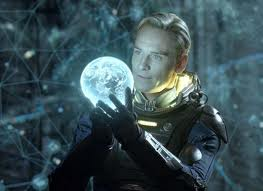
The film opens with a lone figure of an alien creature, likely on Earth, sacrificing himself in some sense. Exactly why it is not clear– but it appears that he is spreading his genetic imprint on the land – providing the ‘fire’ of his genetic intelligence. Thus the film’s ‘Prometheus’ gives of himself to generate new life –displaying one of the core themes of the film: that sacrifice and destruction are required for creation. Our initial Promethean figure is also somewhat Christ-like in that he is willing to give of himself to bring life to others. This Christ-like sacrifice and the inspiration it invokes will be echoed throughout the film in other ways and through several characters, including the principal character of Elizabeth Shaw (powerfully played by Noomi Repace), who not so coincidentally carries a cross as her talisman.

The crew of the story’s interstellar spacecraft (also named ‘Prometheus’) travels to a distant planet in search of the genetic creators of humanity, whose star maps were discovered in cave paintings by Shaw and partner Charlie Halloway (well-played by Logan Marshall-Green in spite of having some of the film’s worst dialog). As the story unfolds, we find that the race of what Shaw refers to as ‘Engineers’ apparently do not think very well of their errant creation, and intended to return to Earth to destroy the human population. Moreover, something stopped the Engineers from doing so (what we do not know — although many conjecture is was the black ooze that could morph into any ill-conceived intention). Those among the Engineers who sought to wipe out humanity would do so with a ‘weapon of mass destruction’ – the black ooze (interestingly reminiscent of crude oil) through which an ill-intended humanity would morph into their own demise.

It is interesting to note here that Mary Shelley’s Frankenstein was subtitled ‘A Modern Prometheus.’ For here the unintended consequences of the opening figure’s sacrifice apparently comes into play. Did that being, in ‘seeding’ the Earth genetically, create a sort of Frankenstein race as a result? Is the human race, in fact, a genetic aberration that must be wiped out? Not only in and of itself, but in what it in turn would attempt to create: an inorganic, soulless Superman via robotics? A race that strings up its altruists on crosses and seeks an unnatural immortality in machines?

The violent reaction of the Engineer ‘awakened’ from his hibernating state  — particularly to the robot figure of David — may in fact be explained in this context. Why did the Engineer react so negatively to the robot? My conjecture is that the evolution of humanity into the ‘perfected next step’ of robotics would be seen by the Engineers as misguided.  In other words, the evolution of humanity into a ‘machine man’ (and corollary ‘corporate human’ as reflected in Charlize Theron’s icey portrayal  of Meredith Vickers) might, to these beings, be an aberration, ‘anti-life’ (anti-Christ?) and immoral.

Some have conjectured that the Engineers were destined to return to Earth to destroy humanity because it had killed Christ on the cross (Ridley Scott himself hinted at this).  If this were the case, certainly the Engineers would dislike where humanity was heading in modern times –i.e., toward creating a new race of robot beings with corporate masters, soulless and without flaws. And they probably would disapprove of the ‘immortality’ touted by Mr. Weyland (the industrialist sponsor of the Prometheus mission played in heavy makeup by Guy Pearce) that David apparently possessed, for it was (as symbolized by the decapitation of David) ‘mind separated from body’ – an unnatural, inorganic, non-genetic ‘Frankenstein’ outcome of immortality without soul that was the pre-ordained result of a humanity that would routinely crucify the innocent. Their robot creations also indicated a singular selfishness in Weyland and Company and the inability to accept death as part of life.

To any defenders of humanity, the ‘perfection’ of the robotic David may be seen as the logical next step of evolution, particularly if such a creature were able to obtain an emotional life and thus a soul. David apparently did develop hatred for Charlie (as his patronizing oppressor and obstacle to his growing love for Elizabeth), and wound up killing him with a genetic concoction that mutated him into a monster. While David’s emotional life was immature and reactionary (even pathological, like some of his human mentors, who would do whatever they could to get what they want), it did show that David’s robot race — and by inference his human creators — perhaps had a potential not seen by the Engineers (or their creators!). For while if a  human cannot physically survive without a body, David could (symbolically ‘transcending’ the body). Ironically, one could argue that David was almost Angelic in his outcome, and not a Frankenstein at all. David, in fact, became Elizabeth’s guide – thus the ‘head guides the heart’ in search of truth, while the heart provides the passion required for survival. A combination of super intelligence and superior passion (compassion?) would indeed be the most formidable survivalist in any Darwinian struggle for dominance. For those interested in dominance and power, the issue of who survives trumps all others.  For the character of Elizabeth Shaw, what leads to the greatest truth is even more important.

And then there is of course the other survivalist: the Alien creature made famous by earlier movies.  Was the final Alien monster creation simply an accident? An unintended consequence of science? It seems so.  And the tragic and unintended consequences of science is again a major theme taken from the Prometheus myth.

Prometheus poses such questions about truth, life, power, sacrifice, creation, death and immortality. The film also portends what may evolve into a very real ethical debate between bio-engineering and robotics regarding the nature of life itself (i.e., can life be only DNA based, or can it be inorganic?). And while the film was pretty derivative and I have some issues with its overall execution (much of it likely due to editing it down to a releasable version and cementing  its ‘prequel’ feel of the Alien movies) I do believe Prometheus opens up a series of questions that lifts it to the level of true science fiction and above the melodramatic ‘cowboys vs. aliens’ that are a mockery of the genre, which at its best forces us to look deeply into questions most often relegated to religion and philosophy.

***

D.R. Thompson is a producer and essayist. His latest book of essays, A WORLD WITHOUT WAR, is available from Del Sol Press.

From The Hollywood Reporter: 

In contrast to previous keynote speakers at the Los Angeles Film Festival who focused on the problems threatening the independent film business, Chris McGurk, chairman and CEO of Cinedigm Entertainment Group, offered an upbeat, sunny assessment Saturday as he predicted a renaissance of independent filmmaking, comparable to that of the late ‘60s and late ‘80s.

More…